
Set the standard before the bids arrive.
Miyar turns a procurement need into a clear, scorable RFP: every requirement measurable, the weights agreed before the bids arrive. Then it measures every bid against the same standard, with a reason and a source page for every score. The committee decides.
- Guided interview turns a need into requirements
- Suggested technical and price weights
- Bid comparison with a reason for every score
- Arabic and English, with Saudi hosting option
- 1Goal: CRM for 300 users
- 2Scope and functional requirements
- 3Evaluation criteria and weights
- 4Terms, schedule and annexes
- every requirement in the RFP
- Measurable
- before the bids arrive
- Weights locked
- a reason and source for every score
- Audit trail
Presentation
Miyar · Product deck
AI RFP builder: set the standard before the bids arrive
Read the presentation· slide by slide, with the presenter's notes
1. Miyar
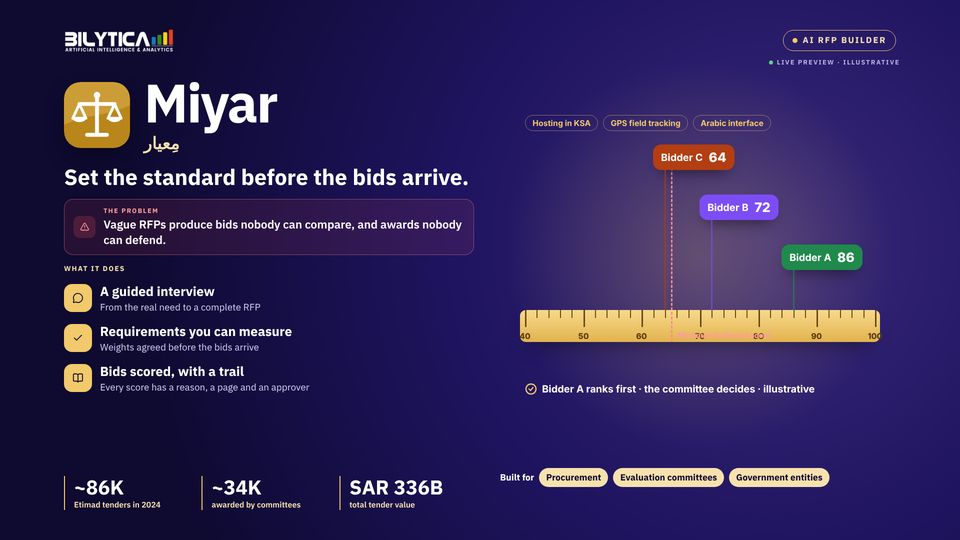
This is Miyar, مِعيار, which means standard, or measure. Miyar turns a procurement need into a clear, scorable RFP, then measures every bid against the same standard. Here, three bids are placed on the same measuring stick, with a minimum technical score, and the committee decides.
2. Where procurement goes wrong
Where does procurement go wrong? At every step. The need starts from last year’s RFP, copied and edited. The RFP uses words like robust and scalable that nobody can score. The bids are compared by hand in spreadsheets. And the weights are argued after the bids arrive. The result: bids you can’t compare, and decisions you can’t defend.
3. It starts with the real need
This is Miyar. In Arabic, miyar means the standard, the benchmark every bid is measured against. Miyar is Bilytica’s AI RFP builder, and its promise is simple: set the standard before the bids arrive. On the right, a team asks for an RFP for a CRM with field tracking. Miyar interviews them like an experienced procurement lead and builds the outline: a CRM for 300 field users, hosted in the Kingdom, with measurable requirements and suggested weights of 70 technical and 30 price. The content is illustrative. The committee always makes the decision.
4. Every requirement, something you can measure
Step two: every requirement becomes something you can measure. Robust and scalable becomes supports 300 field users at the same time. Works offline becomes visits sync within five minutes of reconnecting. And the weights, here technical 70 and price 30, are suggested with the reasoning and agreed before the bids arrive.
5. Every bid, against every requirement
Here is evaluation in action, on an illustrative example. Miyar reads the three bids and extracts each answer. Hosting in Saudi Arabia: A and B yes, C no. GPS field tracking: A and C yes, B partially. Arabic interface: all three yes. The suggested scores are 86, 72 and 64, so bidder A ranks first, with a reason and the source page for every score. The committee makes the decision; Miyar never makes the award.
6. An award the committee can defend
Step four: an award the committee can defend. Every change is recorded, from requirements approved to weights locked, every proposed score with its page, every adjustment with its reason, to the signed recommendation. When someone asks why bidder A, every score has a reason, a source and an approver.
7. Public procurement at a very large scale
Why it matters: in 2024, close to 86,000 government tenders were issued on Etimad, about 34,000 were awarded, each by a committee, with a total value of SAR 336 billion. Every award rests on criteria someone must defend.
8. Fair, traceable, kept in the Kingdom
Miyar is fair, traceable and kept in the Kingdom. It writes in Saudi procurement Arabic and follows how evaluation works here, with separate technical and financial evaluation. It keeps a full audit trail. It can be hosted in the Kingdom, aligned to PDPL, or run fully offline. And buyers write with Miyar while bidders answer with Qalumi.
9. Describe a real need, see the RFP Miyar builds.
The best way to judge Miyar is on your own next tender. Describe one upcoming need in your own words, or bring last year’s RFP. Review a scorable RFP with requirements, weights, terms and annexes. Then, when the bids arrive, see them scored with reasons for your committee. Write to us at sales@bilytica.sa. Thank you.
How it works
From a need to an approved RFP and committee-reviewed comparison
Need
Guided interview
How many users?
300
Hosting?
In Saudi Arabia
Priority?
Field tracking
RFP
Draft RFP
- 1Scope
- 2Requirements
- 3Scoring criteria
- 4Terms and annexes
Tech 70 · Price 30
Decision
Bids compared
- Bidder A86
- Bidder B72
- Bidder C64
Every score traces back to a requirement.
- 01
Describe or upload
Start from your brief or an existing RFP, then answer guided questions on goals, users and constraints.
- 02
Build requirements
Answers become measurable functional and technical requirements.
- 03
Set scoring
Suggested technical and price weights, with flags on anything unmeasurable.
- 04
Issue
A complete RFP with terms, schedule and annexes, in your branding.
- 05
Evaluate bids
Received bids compared against every requirement, with a reason for each score.
What changes
From copying last year's RFP to one built on what you actually need.
Copying and editing an old RFP
An RFP built from an interview about your need
Vague requirements that are hard to score
Measurable requirements with clear thresholds
Unbalanced evaluation weights
Suggested technical and price weights, explained
Comparing bids by hand in spreadsheets
A structured comparison against every requirement
In the cloud, or on your own network
Give the procurement team a shared browser workspace, or run it locally to meet your document policy.
Cloud workspace
Build the RFP and review clauses and scoring with your team, with an in-country hosting option.
On-premises and offline
A local deployment option for document review and RFP drafting without an external connection, when models and resources are configured locally.
The RFP starts with questions, not a template
Miyar asks what an experienced procurement lead would ask: who the users are, what the constraints are, what must be true. The scope and requirements come from the answers.
- Questions that adapt to project type and sector
- Measurable requirements instead of vague phrases
- Reusable library of clauses and terms
- Native Arabic in Saudi procurement language
- 1Goal: CRM for 300 users
- 2Scope and functional requirements
- 3Evaluation criteria and weights
- 4Terms, schedule and annexes
Fair weights before the bids arrive
It proposes evaluation criteria with technical and price weights, and flags requirements that cannot be measured or that narrow competition.
- Suggested weights by project type
- Flags on vague or restrictive requirements
- Clear minimum threshold for each requirement
- Change history and committee approvals
- Functional fit30%
- Approach and team25%
- Security and hosting15%
- Price30%
Flag: the “ERP integration” requirement has no measure. Add a minimum threshold.
A clear comparison of every bid received
Upload the bids you receive. Miyar reads them, compares each against every requirement and criterion, and proposes a score with the reason. The committee decides.
- Each bidder's answer extracted per requirement
- Suggested scores with reason and source
- Gaps and exceptions in bids surfaced
- Evaluation report ready for the committee
| Requirement | A | B | C |
|---|---|---|---|
| Hosting in Saudi Arabia | ✓ | ✓ | — |
| GPS field tracking | ✓ | Partial | ✓ |
| Arabic interface | ✓ | ✓ | ✓ |
| Score | 86 | 72 | 64 |
Bidder A ranks first, with a reason for every score.
Capabilities
Everything a procurement team needs, in one place
Guided interview
Smart questions that turn a need into a clear scope.
Measurable requirements
Every requirement with acceptance criteria and a threshold.
Scoring weights
Suggested technical and price balance, explained.
Terms and annexes
Contract clauses, schedules and annexes ready to use.
Clause library
Your approved clauses, reused across RFPs.
Arabic and English
Native writing in both languages, not machine translation.
Quality review
Flags ambiguity, contradictions and restrictive requirements.
Bid comparison
A scoring matrix for every bid against every requirement.
Committee workflow
Comments, approvals and roles for committee members.
Full audit trail
Who changed what and when, for every RFP.
Ready exports
Word and PDF in your organisation's branding.
Data privacy
Option to host in Saudi Arabia.
Made in Saudi Arabia
Traceable bid evaluation, with a Saudi hosting option.
Bilytica designed Miyar in Riyadh around how procurement works in Saudi Arabia: Arabic documents, separate technical and financial evaluation, and multiple annexes.
- Arabic written in Saudi procurement language
- Option to host data in Saudi Arabia
- Controls to protect RFPs and supplier bids based on deployment configuration and committee permissions
- Built and supported by a Saudi team
Comparison
How Miyar is different
| Capability | Traditional templates | Miyar |
|---|---|---|
| RFP built from the actual need | · | |
| Measurable requirements | Partial | |
| Suggested, explained scoring weights | · | |
| Comparison of received bids | · | |
| Native Arabic writing | Partial | |
| Hosting in Saudi Arabia | · |
Integrations
Works with your team's tools
Connected systems
- ERP
- CRM
- Portals
- Partners
Integration layer
- Secure APIs
- Validation on entry
- Retry and alerting
Data checked on the way
Date 12/05/24 · 2024-05-12One date format
Every system sees the same record
- Source tracked
- Change logged
Frequently asked questions
What is Bilytica Miyar?+
A Saudi-built AI product for procurement teams. It turns a need into a complete RFP with measurable requirements, evaluation criteria and weights, terms and annexes, then compares the bids received.
Does it make the award decision?+
No. It suggests scores with the reason and source; the evaluation committee decides.
Can it use our own templates?+
Yes. Upload your approved clauses and templates and it uses them in every RFP.
How does it relate to Qalumi?+
Miyar is for buyers who issue RFPs; Qalumi is for bidders who write proposals. They are separate products that work together.
Where is our data stored?+
In-country cloud hosting is available, or Miyar can be deployed on-premises and run offline with the required local resources configured.
Describe a real need, see the RFP Miyar builds.
Describe a real need and we will show you the RFP and scoring criteria Miyar produces.