
Every requirement answered. Every answer sourced.
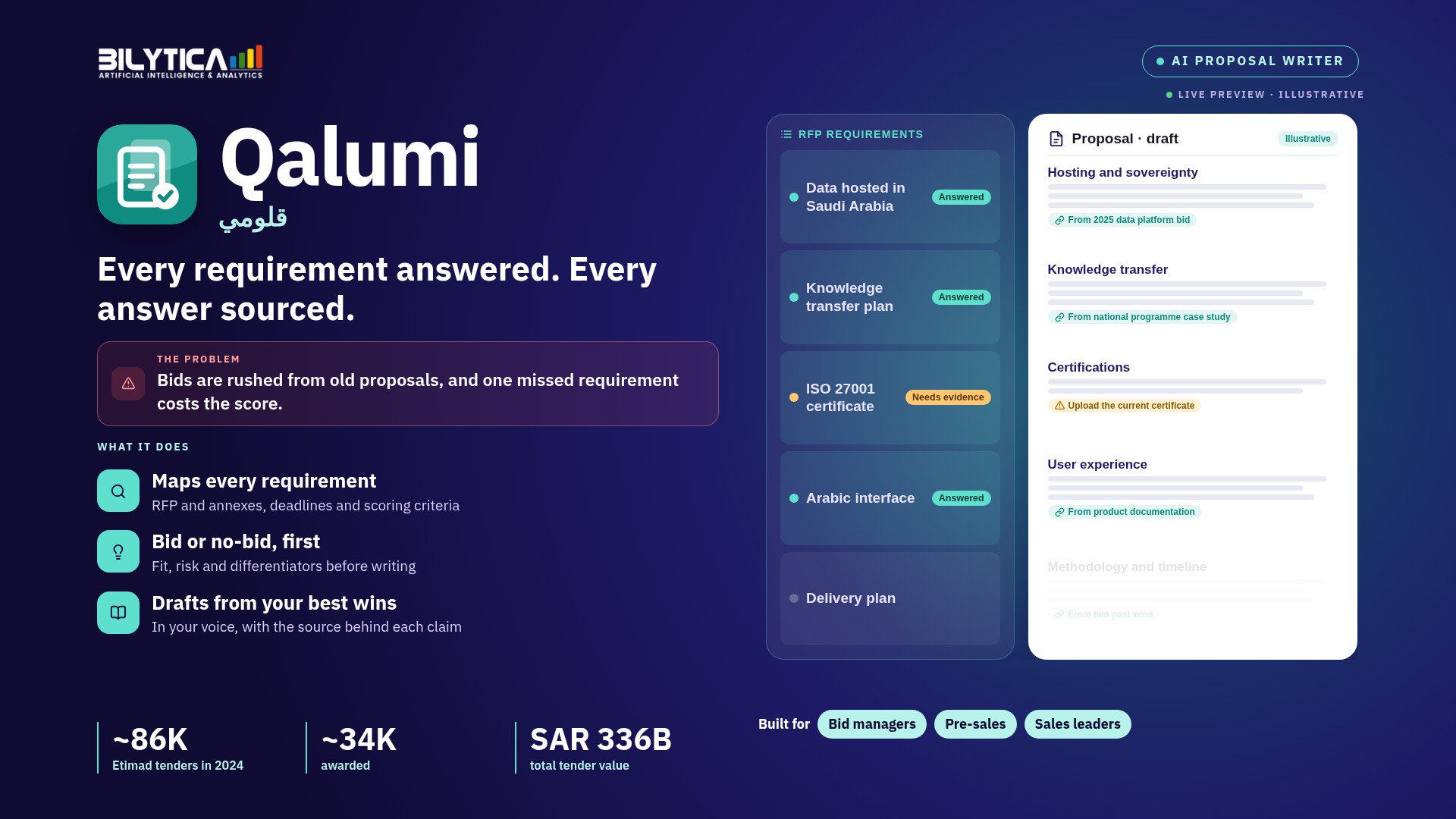
Qalumi is an AI proposal writer. It reads the tender and every annex, maps each requirement, deadline and scoring criterion, gives a bid or no-bid view, then drafts the proposal from your own past wins, with the source behind each answer, ready for your team to review.
- Proposal writer grounded in your past proposals and branding
- Compliance matrix, bid strategy and buyer clarification…
- Knowledge library with the source of every paragraph
- Arabic and English, with Saudi hosting option
RFP: Unified data platform
Requirements mapped to evidence
Review
before approval
- Req 4.2: Data hosted in Saudi ArabiaMet
- Req 5.1: Knowledge transfer planMet
- Req 6.3: ISO 27001 certificateNeeds evidence
- Req 7.0: Pricing scheduleDraft
Assistant suggestion
Check the certificate is current in the evidence library, and review the security section retrieved from a past proposal before using it.
- every requirement, deadline and criterion
- One matrix
- on clear criteria, before anyone writes
- Bid / no-bid
- every claim from your approved library
- Sourced
Presentation
Qalumi · Product deck
AI proposal writer: every requirement answered and sourced
Read the presentation· slide by slide, with the presenter's notes
1. Qalumi
This is Qalumi, قلومي. Qalumi is an AI proposal writer. It reads the tender, maps every requirement, and drafts a proposal from your own past wins, with the source behind each answer, ready for your team to review. Every requirement answered; every answer sourced.
2. The RFP lands on a Thursday. The deadline doesn’t move.
Here is the problem, as one bid week. The RFP lands on a Thursday with nine annexes. Friday is spent reading requirements by hand. Saturday: where is the current ISO certificate? Sunday: the security section is copied from an old bid, and the scoring criteria are buried in annexes. Monday and Tuesday go on CVs, pricing and formatting. On Wednesday the bid is submitted, with one requirement left unanswered. That costs technical points.
3. First, see every requirement
Qalumi starts by reading the RFP and every annex, and mapping each requirement, deadline and scoring criterion into one matrix. You see what your library already answers, what needs evidence, and the gaps to close, before anyone writes. The figures here are illustrative.
4. Bid or no-bid, on clear criteria
Before anyone writes, Qalumi gives a bid or no-bid view on clear criteria: fit with your capabilities, past wins you can reuse, delivery and contract risk, and differentiators. Here the recommendation is to bid, with an infrastructure partner for hosting, and the buyer questions are drafted.
5. Your best past wins, in every answer
Then Qalumi writes each section in your voice, from your approved library: past bids, case studies and CVs. Every claim shows its source, and gaps are flagged, such as confirming the hosting region with the partner. It writes native Saudi business Arabic and English, on your templates and brand.
6. A very large market, won on evidence
Why it matters: on Etimad in 2024, close to 86,000 government tenders were launched, about 34,000 awarded, with a total value of SAR 336 billion. These tenders are won on evidence: every requirement answered, every answer sourced, and time spent on the right bids.
7. Two sides of the same tender
Qalumi has a companion, Miyar. Buyers write clear, scorable RFPs with Miyar; bidders answer every requirement, with evidence, with Qalumi. Qalumi writes Saudi business Arabic, is hosted in the Kingdom or fully offline, and your bids never train public models. It is built by Bilytica in Riyadh.
8. Send us a real RFP, see your next proposal.
The best way to judge Qalumi is on a real tender. Share one live RFP with its annexes. Load your best approved bids, case studies, CVs and templates. Then review the matrix, the bid strategy and a sourced draft in your company’s style. Write to us at sales@bilytica.sa. Thank you.
How it works
From the RFP and your approved knowledge to a reviewed proposal
Inputs
RFP + your knowledge
Past bids · case studies · CVs · templates
Process
Qalumi · proposal writer
Output
Proposal for review
- Executive summary
- Approach
- Team
- Pricing
- 01
Prepare the sources
Add the RFP and annexes alongside approved past bids, case studies, CVs and templates.
- 02
Read the RFP
AI extracts requirements, deadlines and scoring criteria into a compliance matrix.
- 03
Bid or no-bid
Review opportunity fit, risks and differentiators before writing starts.
- 04
Draft from evidence
Relevant material is retrieved from your library to write a response per requirement, showing its source and gaps.
- 05
Review and approve
Section owners check claims, evidence and missing answers before exporting the approved Word or PDF.
What changes
The RFP lands on a Thursday. The deadline doesn't move. From a week of copy and paste to a structured proposal you review and approve.
Reading a 200-page RFP by hand
Every requirement, date and criterion extracted
Copying sections from old bids
A draft in the style of your best past wins
Finding a missed requirement after submission
A compliance matrix before you send
Formatting that differs every time
Your branding applied on every page
A cloud workspace, or inside your premises
The same bid workflow for your team: upload the RFP, review the draft and approve the final version. Choose the deployment that fits your data policy.
Cloud, in your browser
Work together on proposals and reviews in a shared workspace, with an in-country hosting option.
On-premises and offline
A local deployment option for organisations that need documents and processing to remain on their own network, with models and resources configured locally.
From previous evidence to a reviewable answer
Qalumi draws from approved past proposals, case studies, CVs and templates. It retrieves relevant evidence for each requirement and drafts traceable responses in your team’s voice; previous answers still need review for currency and accuracy.
- Knowledge library from past proposals, with the source of every paragraph
- Logo, fonts, colours and slide templates applied automatically
- Answers for security questionnaires and due-diligence forms
- Team collaboration with section owners and review history
RFP: Unified data platform
Requirements mapped to evidence
Review
before approval
- Req 4.2: Data hosted in Saudi ArabiaMet
- Req 5.1: Knowledge transfer planMet
- Req 6.3: ISO 27001 certificateNeeds evidence
- Req 7.0: Pricing scheduleDraft
Assistant suggestion
Check the certificate is current in the evidence library, and review the security section retrieved from a past proposal before using it.
Decide what to pursue before you write
It compares the RFP with your capabilities and evidence, proposes differentiators, flags risks and drafts clarification questions for your team to review before sending them to the buyer during the query window.
- Bid or no-bid assessment on clear criteria
- Differentiators mapped to evaluation criteria
- Clarification questions for review before sending
- Alerts on high-risk contract terms
Opportunity fit
Needs review
Differentiator
Local hosting and Arabic support
Risk
Late-delivery penalty clause
Clarifications
Suggested buyer questions
Capabilities
Everything a bid team needs, in one place
RFP analysis
Breaks the document into requirements, dates, criteria and annexes.
Compliance matrix
Maps every requirement to the section that answers it and shows gaps.
Bid or no-bid
Reviews fit and risks before the team spends time.
Buyer clarification questions
Suggested clarification questions from ambiguity in the RFP.
Knowledge library
Proposals, case studies, CVs and certificates kept current.
Company branding
Word and slide templates with your logo and fonts.
Arabic and English
Native writing in both languages, not machine translation.
Team workflow
Section owners, comments and approvals.
Learns from outcomes
Win and loss tracking improves the next proposal.
Terms review
Flags penalties and high-risk contract clauses.
Ready exports
Word, PDF and presentation files in final format.
Data privacy
Your data never trains public models, with a Saudi hosting option.
Made in Saudi Arabia
Arabic tenders, with traceable evidence.
Bilytica designed Qalumi in Riyadh around how tenders work in Saudi Arabia: Arabic documents, multiple annexes, and separate technical and financial evaluation.
- Arabic written in Saudi business language
- Option to host data in Saudi Arabia
- Controls to protect proposals and evidence based on deployment configuration and team permissions
- Built and supported by a Saudi team
Comparison
How Qalumi is different
| Capability | Answer-library tools | Qalumi |
|---|---|---|
| Questionnaire answers from a content library | ||
| Full proposal in company voice and branding | Partial | |
| Bid strategy and client questions | · | |
| Native Arabic writing | · | |
| Hosting in Saudi Arabia | · |
Integrations
Works with the tools your team already uses
Connected systems
- ERP
- CRM
- Portals
- Partners
Integration layer
- Secure APIs
- Validation on entry
- Retry and alerting
Data checked on the way
Date 12/05/24 · 2024-05-12One date format
Every system sees the same record
- Source tracked
- Change logged
Frequently asked questions
What is Bilytica Qalumi?+
An AI proposal writer for bid teams. It reads RFPs, maps requirements to approved past proposals and evidence, then drafts sourced answers in your company's voice for team review. Buyers use its companion product, Miyar.
How does it learn our writing style?+
You upload past proposals, case studies and presentation templates. It builds a knowledge library and style profile used in every draft, and shows the source of each paragraph.
Does it submit proposals without human review?+
No. It drafts and checks compliance; your team approves the final version.
How is it different from Loopio or Responsive?+
While answer-library tools help reuse questionnaire content, Qalumi connects RFP requirements to your approved evidence and drafts a proposal in your branding, with source and gap review by your team.
Is there a product for writing RFPs?+
Yes. Miyar is a separate AI RFP product for procurement teams. It complements Qalumi for bid teams.
Can Qalumi run offline?+
An on-premises deployment option can run without an internet connection when the required models and resources are configured locally. A cloud workspace is also available.
Where is our data stored?+
Hosting in Saudi Arabia is available, and your data is never used to train public models.
Send us a real RFP, see your next proposal.
Send us a real RFP and we will show you the analysis, the compliance matrix and a draft in your company's style.