
What is a data warehouse, and does your company need one?
A plain explanation of data warehouses, lakes and lakehouses, the signs that your company needs one, and what a buyer should expect to receive.
Key takeaways
- Systems run the business; a warehouse lets you see across it.
- Manual spreadsheet reporting and conflicting numbers are the clearest signs of need.
- Cloud, lakehouse and on-premises designs are all valid; data classification decides.
- Expect pipelines, models, definitions, quality checks and handover, not only storage.
Live Bilingual Ministerial Reporting
An SDAIA-aligned data platform with Arabic-English ministerial dashboards.
- Sovereign Data PlatformIn-country hosting, NDMO-aligned
- Vision 2030 KPIsLive tracking of national NTP indicators

“Ministerial reporting moved from monthly PDFs to live bilingual dashboards, every Vision 2030 KPI updated daily and shared across agencies.”
Quick answer
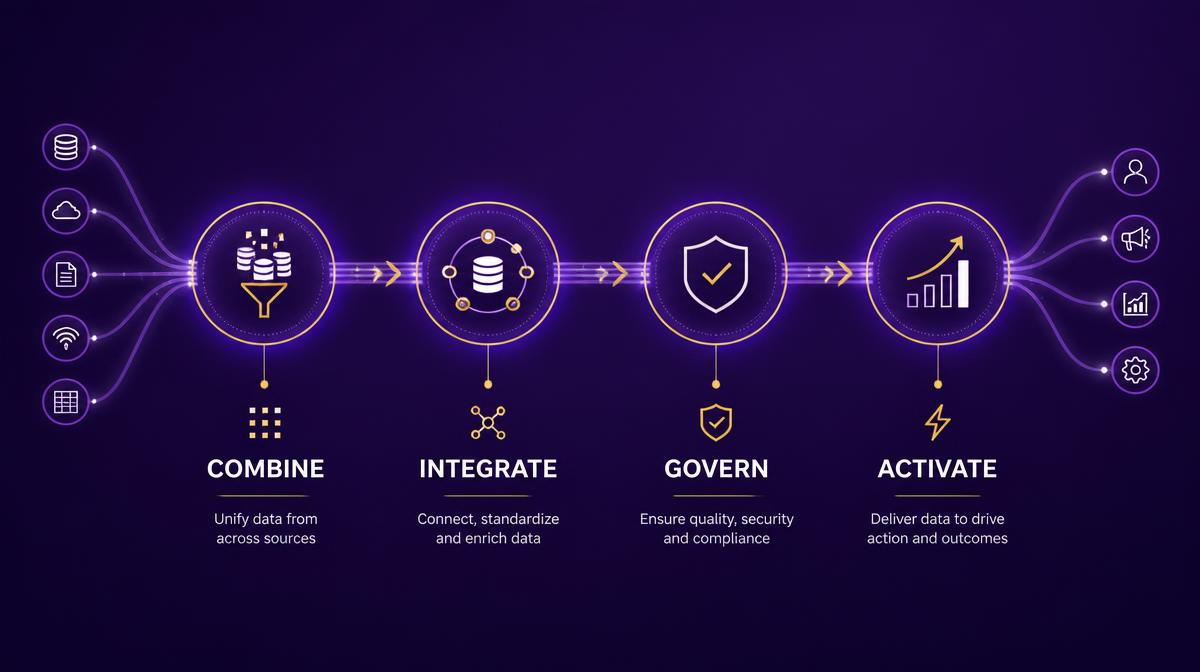
A data warehouse is a central, organised store that brings data from your business systems (ERP, CRM, finance, HR and operations) into one place, cleaned and modelled so it can be reported on consistently. Your systems run the business; the warehouse lets you see across it. A company usually needs one when important reports depend on manual spreadsheet work, when departments bring different numbers to the same meeting, or when it plans to use AI on its own data.
Database, data warehouse and data lake: the plain difference
- Operational database: sits behind one application, such as your ERP. It is built to record transactions quickly, not to answer questions across the whole company.
- Data warehouse: combines data from many systems into structured tables designed for reporting and analysis. Definitions are agreed and history is kept.
- Data lake: stores large volumes of raw data in its original form, including files, logs and documents. It is flexible and inexpensive, but hard to use without structure on top.
- Lakehouse: keeps data in open file formats in a lake while adding warehouse-style tables, governance and performance. Microsoft Fabric, Databricks and Snowflake all support designs along these lines.
Signs your company needs a data warehouse
- Monthly or weekly reports take days of copying and reconciling spreadsheets.
- Finance, sales and operations quote different figures for the same question.
- Reports slow down your ERP or other live systems when they run.
- You cannot easily compare this year with earlier years because older data sits in retired systems.
- You want to try AI assistants or forecasting, but no one is sure which data is reliable.
If none of these apply, a well-run reporting tool on top of a single system may be enough for now.
What a modern warehouse looks like
Most new warehouses are built on cloud platforms such as Microsoft Azure and Microsoft Fabric, Snowflake or Databricks, which scale with use and remove much of the hardware work. Some organisations, particularly those handling sensitive or classified data, keep the warehouse on-premises or with a local hosting provider. The right choice depends on your data classification, existing licences and team skills.
A common way to organise the data is in layers: a raw layer that keeps an exact copy of each source, a cleaned layer where duplicates and errors are fixed, and a business layer with agreed definitions that reports and AI use. This is often called a medallion design, with bronze, silver and gold layers.
What a buyer should expect to receive
A warehouse project should give you more than storage:
- Pipelines from each agreed source system, running on a schedule and monitored.
- Data models that match how the business thinks: customers, products, orders, invoices and employees.
- Documented definitions for key measures such as revenue, margin or on-time delivery.
- Data quality checks, with alerts when something breaks.
- Access controls, so people only see what they are allowed to see.
- A first set of reports that answer real management questions.
- Documentation and training, so your team can run and extend the platform.
Questions to ask before you build
- Which decisions and reports will the warehouse serve first?
- Which source systems are in scope, and who owns each one?
- Where must the data be stored, given its classification and privacy obligations?
- Who will own definitions and data quality once the project ends?
- How will costs behave as data volume and the number of users grow?
- Can we start with one subject area and expand, rather than building everything at once?
Next step
Bilytica designs and builds warehouses and lakehouses on Azure, Microsoft Fabric and other platforms, starting from the decisions they need to support. To discuss your situation, contact our team or see how we approach the data foundation for AI.
Frequently Asked Questions
What is the difference between a database and a data warehouse?
A database sits behind one application and is designed to record transactions quickly. A data warehouse combines data from many systems into structured tables designed for reporting, analysis and history.
Is a data lake better than a data warehouse?
They serve different needs. A lake stores large volumes of raw data cheaply, while a warehouse provides structured, agreed data for reporting. Many organisations now use a lakehouse, which combines both approaches.
Can a data warehouse run on-premises in Saudi Arabia?
Yes. Organisations with sensitive or classified data can keep the warehouse in their own data centre or a local hosting environment. The choice should follow data classification, privacy obligations and existing skills.
Do we need a data warehouse before using AI?
Not always, but AI needs reliable, well-defined data. For most companies the cleaned, governed layer of a warehouse or lakehouse is the most practical source for AI assistants, forecasting and agents.
Want These Results for Your Company?
Book a free AI assessment and see exactly how much you can save, with numbers, not buzzwords.