TrackQlik · Product deck
Field inspections with verified visits and evidence
TrackQlik
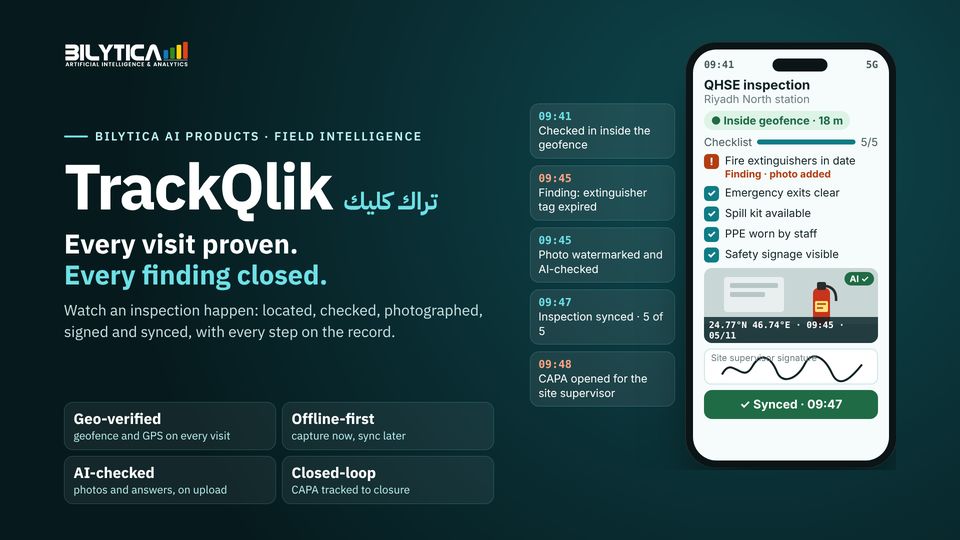
This is TrackQlik, تراك كليك, Bilytica’s AI field intelligence platform for inspections, surveys and audits. Its promise: every visit proven, and every finding closed. On the screen, an inspection is happening live. The inspector arrives at the Riyadh North station and the app confirms she is inside the geofence, 18 metres from the site. She works through the checklist; the first item, fire extinguishers, fails, so she adds a photo. The photo is stamped with the GPS position and time, and AI checks it on upload. She completes the remaining items, the site supervisor signs, and the inspection syncs at 09:47. One minute later a corrective action is opened for the supervisor. Every step lands on the record you see on the left. Four things make this possible: every visit is geo-verified, the app works offline, AI checks photos and answers on upload, and every finding is tracked to closure.
What reaches head office today
Why does TrackQlik exist? Look at what reaches head office today. This is a typical field team group chat. Khalid writes “Visited Dammam depot, all good”, with no location, no time stamp and no evidence he was there. Faisal says he will send the checklist tomorrow, and it arrives as version three of a spreadsheet. Huda sends a photo captioned “shelf”, and the area manager has to ask which branch it is from. Then he asks who is fixing the spill kit, and nobody answers. Four problems: no proof of the visit, paper typed up days later, evidence without context, and findings with no owner. By the time the monthly report arrives, the shelf is empty, the hazard is still there, and nobody can say who visited.
From route, to record, to decision.
How does it work? Follow one visit, minute by minute. At 08:00 the supervisor assigns a route: twelve sites in the Eastern region. At 09:41 the inspector checks in on site, and TrackQlik confirms she is inside the geofence, 18 metres from the site. By 09:45 the checklist is complete, five of five items, with every photo watermarked. At 09:46 AI flags a finding: the extinguisher tag has expired. At 09:48 a corrective action is opened, owned by the site supervisor, with a 24-hour deadline. And at 10:30 the regional manager sees it live on the dashboard. Plan, execute, AI check, fix and decide, all the same morning, not at month end. In Present mode, the steps appear one by one.
A visit only counts when it is proven
The first major feature is field proof: a visit only counts when it is proven. On the right, watch what happens. The inspector is still 240 metres away, so the app refuses the check-in. She walks to the site; the moment she is inside the geofence, the check-in is accepted, 18 metres from the centre. She takes a photo, and it is stamped with the exact GPS position and time. Then the evidence builds up: a selfie to verify who is there, the supervisor’s signature, the asset barcode, and finally the sync, which works even if she was offline. Behind this sit four capabilities: geofenced check-in, watermarked evidence, full offline capture, and a template builder with conditional logic and calculated fields, in Arabic and English.
AI spots the problem. CAPA makes sure it’s fixed.
The second major feature is survey intelligence, joined to CAPA. AI spots the problem, and the corrective action makes sure it is fixed. Watch the left panel: the moment data syncs, alerts arrive. Computer vision sees a shelf photo at the Jeddah branch that does not match the planogram, with 94 percent confidence. Anomaly detection flags an answer at the Dammam depot outside that site’s usual pattern, at 88 percent. Route analysis shows three sites in the Eastern region behind today’s route. On the right, the shelf gap becomes a CAPA: raised at 09:42, assigned to the store supervisor with 24 hours to fix, escalated automatically to the area manager when it runs late, and closed only with photo proof on the next visit. The status and the clock update as it moves, so everyone can see where it stands.
One truth on every screen, updated live
This is what transparency means in practice: one truth, three screens, updated live. The inspector sees her day on the mobile app: four of six visits done, one finding at the Riyadh North station, and the Sulay warehouse survey next at 11:30. The supervisor sees the corrective-action queue: the expired extinguisher is assigned and due in 23 hours, the Jeddah shelf gap is two hours late and has been escalated, and the Dammam spill kit is closed with photo proof; twelve open, two overdue, thirty-one closed this week. And leadership sees compliance by region today: Riyadh 96 percent, Makkah 92, the Eastern region 84, with 38 of 40 visits covered. These figures are illustrative. The point is that nobody has to say “send me the report” again: head office sees the same evidence the inspector captured, the moment it syncs.
The jobs TrackQlik was built for
Where does TrackQlik fit best? In four jobs it was built for. The first is store audits and planogram checks in retail and FMCG. Today merchandisers send shelf photos on WhatsApp, and gaps only show up in the month-end report. With TrackQlik, every store visit is geofenced, AI checks each shelf photo against the planogram, and every gap becomes a tracked action. This fits retail chains and FMCG distributors with merchandising teams. The second is QHSE and safety inspections at stations, plants and sites. Today paper checklists are filled in later, and the same hazard returns on the next visit. With TrackQlik, a guided checklist runs inside the site boundary, evidence is watermarked, and critical findings raise an instant alert. This fits fuel station networks, energy and manufacturing. The third is asset surveys in telecom, utilities and real estate. Today the asset register is out of date, and nobody can prove when an asset was last seen. With TrackQlik, each asset is scanned by barcode with photo evidence, even offline at remote sites, and synced to the ERP. The fourth is maintenance and service visits for facility management companies and contractors. Today a client disputes a visit or a service-level agreement, and there is no proof the technician was there. With TrackQlik, routes are planned, the technician checks in at the site, the client signs, and findings are closed with photo proof. These are typical scenarios, not named customer results.
The best fit is a team that must prove its field work
Is TrackQlik right for you? The best fit is a team that must prove its field work. It is a strong fit if your people visit many sites, such as stores, stations, towers, buildings or client premises. If you must prove that the visit happened, to a client, a regulator or head office. If findings need an owner and follow-up across regions and branches. And if evidence travels today on paper, in Excel or on WhatsApp. It is probably not the right fit yet if you run a single site with no field team, or if you only need a one-off survey. And if you also need sales and projects, VoomHub adds CRM, projects and marketing to field operations, and the two integrate.
Built for Saudi field teams, not generic forms
Why is TrackQlik different? Because it is built for Saudi field teams, not as a generic form tool. Compare it with generic form tools. They do not verify visits with a geofence; TrackQlik does. They do not check photos and answers with AI; TrackQlik does. They have no built-in CAPA tracked to closure; TrackQlik does. They offer offline operation and multi-region control only partially; TrackQlik offers both in full. And it is made in Saudi Arabia: a full Arabic and English interface, hosting inside the Kingdom aligned with the Personal Data Protection Law, multi-region hierarchies for large enterprises, and a Saudi team that builds and supports it. Typical use cases are QHSE inspections, store and station audits, asset surveys and preventive maintenance. And it connects to the systems you already run: VoomHub, SAP, Salesforce, Power BI, WhatsApp, a REST API and Excel export.
A Riyadh data and AI company, built for the Kingdom
TrackQlik is built by Bilytica, a Riyadh data and AI company founded in 2015. Since 2015, we have built trusted data, sovereign AI and AI agents for organisations in the Kingdom, and products that lead their markets. More than 200 Saudi organisations work with us, among them stc, PIF, NEOM, the Ministries of Interior and Health, Mobily, Najm and Elm. Our AI handles more than 600 million interactions a year. We have nine AI products, offices in five countries, and our headquarters in Riyadh. Our ventures lead their markets too: Cloudpital runs more than 400 clinics, and PayPeople serves more than 900 businesses. In 2025 we signed an MoU with the Saudi AI Society, under SDAIA’s technical supervision.
Show us one inspection. We’ll show you the proof.
Let’s start. Show us one inspection, and we will show you the proof. Bring one inspection, audit or survey process, on paper or in a spreadsheet. We will turn it into a verified digital form with survey intelligence: geofenced, watermarked, checked by AI, and linked to corrective actions. Book a TrackQlik demo: your checklist goes in, and a geo-verified inspection comes out. Write to sales@bilytica.sa. Thank you.