Idrak · Product deck
Private, on-premises AI with built-in models
Idrak
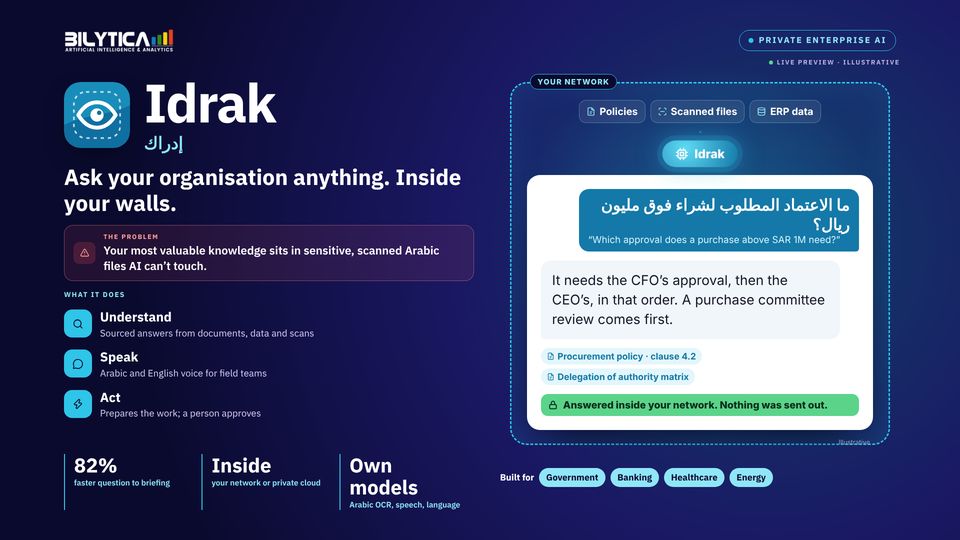
This is Idrak, إدراك, Bilytica’s private enterprise AI. Ask your organisation anything, in Arabic, inside your walls. Here someone asks, in Arabic, which approval a purchase above one million riyals needs. Idrak searches your policies, scanned files and ERP data inside your network, answers with the exact clause it came from, and nothing is sent out. It understands, it speaks, and it acts with your approval. At a national programme office, Bilytica sovereign AI made the path from question to briefing 82% faster.
Three walls stand between your people and what your organisation knows
Here is the problem. Three walls stand between your people and what your organisation knows. Language: the knowledge sits in scanned Arabic files mixed with English terms. Scattered: it lives across files, systems and inboxes. Sensitive: it cannot be sent to public AI. So today people ask people, answers take days, and the most valuable files stay unused.
Your most valuable knowledge is also your most sensitive
Why does Idrak exist? Because an organisation’s most valuable knowledge is also its most sensitive. Teams want AI on their policies, contracts and case records, and those are exactly the files that cannot leave the network. Four problems follow. Public AI means data leaves your boundary: sensitive records cannot be sent to an outside model and its logs. Global models stumble on Arabic: they are trained mostly on English, so scanned Arabic documents, Saudi voice and mixed Arabic–English text lose meaning. Generic chat ignores who may see what: an assistant that reads everything shows everyone everything. And AI that acts without a checkpoint is a risk: changing a record or sending a request needs a person’s approval. PDPL, NDMO and NCA controls follow the data wherever the AI runs. Idrak’s answer is to bring AI that is trained for Arabic to the data, inside your boundary.
One private brain, three abilities
Meet Idrak: one private brain with three abilities. It understands: ask in Arabic or English and get an answer from your documents, data and scans, with the source. It speaks: talk to it hands-free, in Arabic or English. And it acts: it prepares the task and the next step, and a person approves before anything changes. Models, data, logs and decisions all stay inside your network.
Our own models, trained for how Saudi teams write
This is what makes Idrak different: the models are our own. We start from leading open-weight models, such as Qwen for language. Then Bilytica fine-tunes them on Arabic, Saudi and bilingual data, and quantizes them so they run efficiently on your own hardware, inside your boundary. There are three families. Our OCR models read scanned and photographed pages in Arabic, English or both, including tables and forms. Our speech models turn spoken Arabic and English into text and speak back, tuned on how people in the Kingdom actually speak. And our language models reason across Arabic and mixed Arabic–English data, for questions, summaries and agents. Why does this matter? Because real Saudi data is mixed. A manager types the line at the bottom: “How much was the revenue for the Jeddah branch in Q3?”, in Arabic, with an English word and a quarter code in the same sentence. General-purpose models, trained mostly on English, stumble on that. Ours are trained for it. That is why Idrak is built for data bots and data intelligence on Arabic data. And before go-live, we test accuracy on your own material.
It reads what other AI can’t: scanned Arabic
Idrak reads what other AI can’t: scanned Arabic. Bilytica’s own OCR model reads stamped and signed pages, keeps tables as tables, and turns them into structured records. Here a scanned purchase order becomes a record with the supplier, the line items, the total and its status, searchable in seconds and linked back to the source page.
Built for speed, scale and privacy
Good models are only half the story. The other half is the engine around them. Idrak runs in layers, each designed for efficiency. At the top are your teams and apps: data bots, data intelligence, voice and agents. Below that is governance: access rules, approved sources, the audit trail and human approval. Then orchestration and queuing, which routes every request to the right model and queues it, so many people can work at the same time. Then optimised inference: quantization, batching and caching, so each GPU serves more answers. Then the models Bilytica has trained for Arabic OCR, speech and language. And underneath, your own infrastructure: on your premises, where an air-gapped configuration can be evaluated when your data classification calls for it, or in an isolated private cloud. What this means for you: you need fewer GPUs, because quantized models fit modest local hardware; many users can work at once, because queuing keeps answers steady at peak demand; and nothing leaves, because models, data and logs stay where you decide. PDPL, NDMO and NCA controls are assessed against your data, sector and deployment, and we provide the audit evidence.
Same question. The answer follows who is asking.
The first major feature is Understand: answers from your own knowledge, filtered by who is asking. Idrak uses permission-aware search: it finds the relevant passages in approved sources, then filters them against the requesting user’s access. Access follows the source: identities and roles are mapped before anything is indexed, and tested with real user roles before wider use. And every answer shows its source: the clause, page or record behind it is recorded with the answer. On the right is an illustrative example. An employee asks which approval applies to a purchase. Idrak retrieves the policy that applies to that person’s role, shows the relevant clause, and flags what still needs a human decision. The source is recorded, access is role-based, and the exchange is logged for review. Here, the same question gets a full answer for a finance manager and a limited one for a procurement officer.
A voice that speaks your organisation’s language
The second major feature is Speak: a voice that speaks your organisation’s language. Idrak supports Arabic and English, in text and in voice, on speech models Bilytica has trained on Arabic and Saudi speech, drawing on the same approved knowledge. It uses your own terms: institutional terminology and Saudi phrasing are tested on your own material before anyone relies on it. And it works hands-free in the field: inspectors, engineers and service teams can ask out loud and get the procedure back. In this illustrative example, someone on site says in Arabic, “Explain this procedure while I am in the field,” and Idrak replies with step-by-step guidance read from the current approved version of the procedure.
AI agents that act, with a person in control
The third major feature is Act: AI agents that take action, with a person in control. The principle is that an answer is not an action. Changing a record, sending a request or triggering another system follows its own approval path, in three steps. First, an authorised request: Idrak retrieves only what the user may access and records the source. Second, a sourced answer or a prepared task: it answers, or prepares the action if that use case allows it. Third, approval before change: an authorised person reviews consequential changes, and the decision and result are recorded. For example, a service team says, “Summarise this case in Arabic and prepare the next step.” Idrak drafts a sourced summary and proposes a task, and the team reviews it before any system is updated. You decide which tasks are read-only and which can write back.
Deployed your way. Governed your way.
Idrak is deployed your way and governed your way: on your premises, or in an isolated private cloud. Access follows your source systems, mapped before anything is indexed. Every answer is logged with its sources and user. People approve actions. PDPL, NDMO and NCA controls are assessed for your data and sector. And your data never leaves to train anyone else’s model.
A specific job, not an open-ended demo
Each Idrak use case is a specific job, not an open-ended demo. It starts with the source of truth, the decision owner and the allowed action. Three illustrative workflows. A data bot: “What was Jeddah’s Q3 revenue, by product?” Idrak answers from the approved dataset, in Arabic or English, and shows where the figure came from. This is where our Arabic-trained models matter most: data questions are usually asked in a mix of Arabic and English. Operations: “Summarise this scanned file and prepare the next step.” Our Arabic OCR reads the scan, Idrak drafts a sourced summary and proposes a task, and the team reviews it first. Field: “Explain this procedure while I am on site.” Idrak gives voice guidance from the current approved procedure. The value: sensitive knowledge stays inside your boundary; models built for Arabic, voice and mixed-language data; answers in seconds instead of searching through folders; and audit evidence for your compliance reviews. These are illustrative workflows, not published customer results. As proof of what Bilytica delivers in sovereign AI: at a national programme office, private AI on governed data now takes leaders from question to briefing 82 percent faster.
Start with one use case from your own data.
How do we start? With one use case from your own data, in three steps. Discovery: we define the boundary together: your sources, your data classes, the deployment option, and who may see what. Pilot: we prove one job, a single use case with a defined task, a review point and a traceable result. Operate: we run it and expand, with clear owners for refreshing source indexes, updating models and reviewing logs. The next step is a demo, where we talk through your knowledge sources, your deployment boundary and what agents should be allowed to do. Write to sales@bilytica.sa. Thank you.