Bilytica Frameworks · In depth
The Bilytica AI Operating System, framework by framework
Bilytica Frameworks
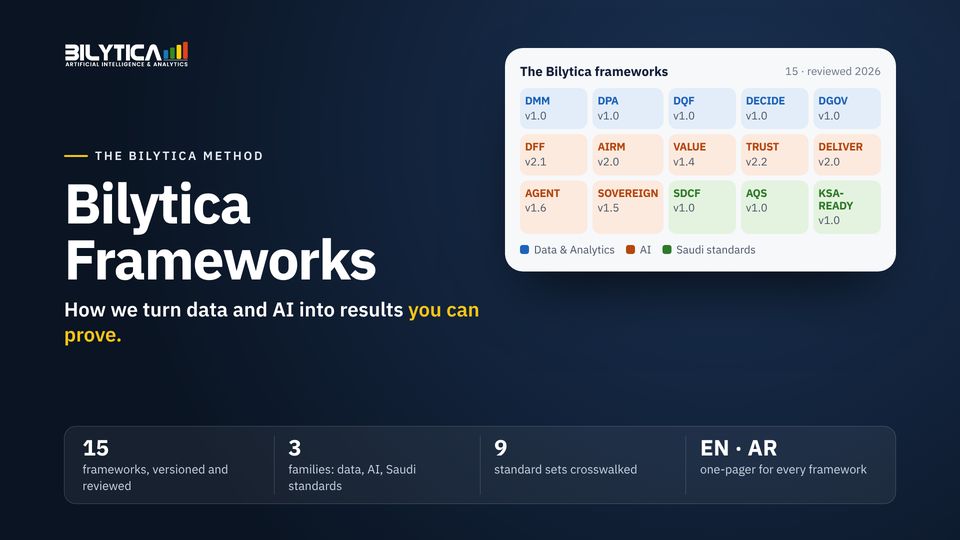
This deck explains the Bilytica Frameworks: the method behind every Bilytica engagement, and the reason our data and AI work reaches production and can be proven. There are fifteen frameworks, each versioned and reviewed in 2026, grouped into three families. The Data and Analytics Operating System makes data trusted, governed and used. The AI Operating System takes AI from readiness and value through delivery, agents and sovereignty. And the Saudi Data and AI Standards build Saudi regulation, Arabic quality and in-Kingdom deployment into the design. Together they are crosswalked to nine sets of standards, from NIST and ISO 42001 to PDPL, NDMO and NCA, and every framework has a one-page summary in English and Arabic.
Most AI programmes don’t fail on the model
Why do frameworks matter? Because most AI programmes do not fail on the model. They fail on the data under it, the business case for it, the controls around it, and the question of who owns it. These are the sentences we hear inside organisations. “Which number is right, finance or sales?” is a data problem, and the Data Foundation Framework answers it. “We have many pilots and nothing in production” is a readiness problem, answered by the AI Readiness Model. “What did we get for last year’s AI budget?” is a value problem, answered by the AI Value Framework. And “Nobody owns this table” is an ownership problem, answered by the Data Governance Operating Model. The model is rarely the problem. The method around it is, and that is what the Bilytica frameworks fix.
The whole system on one page
Here is the whole system on one page: fifteen frameworks in three families, and one way of working across all of them. Family one, the Data and Analytics Operating System, has five frameworks: the Data Management Maturity Model, the Data Platform Architecture Framework, the Data Quality and Observability Framework, the Analytics and Decision Framework, and the Data Governance Operating Model. Family two, the AI Operating System, has seven: the Data Foundation Framework, the AI Readiness Model, the AI Value Framework, the AI Assurance Framework, the AI Delivery Framework, the Agent Operations Framework and the Sovereign AI Framework. Family three, the Saudi Data and AI Standards, has three: the Saudi Data Compliance Framework, the Arabic Quality Standard and the In-country Deployment Framework. A client rarely needs all fifteen at once. We start from the problem and pick the one or two that fit.
The principles behind every framework
What makes these frameworks different from a consultancy methodology slide? Six principles run through all fifteen. First, gates, not guidelines: every stage ends with a “done when” test, and if the test is not passed, the next stage does not start. Second, evidence from systems: scores and controls cite artefacts taken from your systems, not answers to a questionnaire. Third, Saudi first, global underneath: one control set answers both the Saudi reviewer and the international auditor. Fourth, Arabic is measured: Arabic quality is a release condition, never assumed from an English benchmark. Fifth, you keep the artefacts: data contracts, evaluation sets, runbooks and registers stay with your team after we leave. And sixth, honesty about fit: every framework states plainly when it is probably not yet the right one for you.
Every framework is built the same way
Every framework is built the same way, so a client who has used one already knows how the next one works. Each has five to seven stages, and each stage is closed by a “done when” test. Each names an owner on the client side: who runs it and who signs it off. Each leaves three working artefacts that the client keeps, not a slide report. Each has maturity levels, so you know where you are today and what the next level asks for. Each is crosswalked clause by clause against Saudi and international standards. And each is versioned, reviewed in 2026, with a one-page summary in English and Arabic. On the right is a specimen, the Data Foundation Framework, version 2.1. Its five stages are capture, contract, consolidate, curate and certify. Notice the gates: a source is not captured until it has a named owner; a contract is not done until a breach fails the build; certification is not done until the tests pass on a schedule, not once. The client keeps the domain data contracts, the AI-ready certificate and the metric dictionary.
Start from your problem, not from our catalogue
Where should a client start? From their problem, not from our catalogue. Most organisations meet these challenges in this order, so we ask which one sounds like them today. One: our data is scattered and nobody trusts it; that is the Data Foundation Framework. Two: we do not know where AI will work; that is the AI Readiness Model. Three: our ideas need a business case; that is the AI Value Framework. Four: AI use needs controls before it can scale; that is the AI Assurance Framework. Five: a solution has to go live, not stay a pilot; that is the AI Delivery Framework. Six: our agents need clear limits; that is the Agent Operations Framework. For questions about the data estate itself, or about Saudi regulators, the data and Saudi families take over, as the next slides show. And by sector: in energy and utilities, where we predict equipment failures and forecast demand for plants, grids and water networks, we typically apply the Data Platform Architecture Framework, the AI Delivery Framework and the Sovereign AI Framework.
Data you can trust, and use.
Family one is the Data and Analytics Operating System: data you can trust, and use. Its five frameworks help an organisation know where it stands, build the platform, keep data honest, and turn it into decisions people act on. The Data Management Maturity Model gives an honest score of how well data is managed. The Data Platform Architecture Framework is the decision path from source to serving layer, with the trade-offs written down first. The Data Quality and Observability Framework treats a bad number like an outage. The Analytics and Decision Framework goes from a metric tree to a decision that actually changes, instead of another dashboard nobody opens. And the Data Governance Operating Model makes governance run weekly, instead of a charter on a shelf.
Measure the data estate, then govern it
The first pair: measure the data estate, then govern it every week. The Data Management Maturity Model gives an honest score of how well data is managed, from reactive fixes to a managed estate. Its stages are scope, evidence, score, prioritise and re-score. The key gate is in the evidence stage: no score rests on a questionnaire answer alone. And maturity is measured per domain, never as one average number, because an average hides the domain that is actually blocking the programme. The client keeps a scored maturity radar, a prioritised gap register and a reusable test set, so the next score is comparable. The Data Governance Operating Model turns governance into something that runs weekly. Its stages are mandate, roles, policy, enforce and run. Our test of governance is not the number of policies, but whether an unapproved dataset can reach production, and whether anyone would notice. So the first gate is that the governance council has written authority to block a release. The client keeps the operating model, an enforced policy set and an exception register.
Design the platform, then keep data honest
The second pair: design the platform, then treat bad data like an outage. The Data Platform Architecture Framework is a decision path from source to serving layer, with the trade-off written down before the build. Its stages are workload profile, reference decision, layer design, cost and controls, and a governed slice. In the reference decision, the rejected options are documented with the reason, so a later team understands why. Our rule is that a platform is judged by the second workload, not the first: if workload two does not reuse the layers, the design has not landed. The client keeps the target architecture, the layer and promotion standard, and a unit cost model. The Data Quality and Observability Framework uses live monitors and clear escalation. Its stages are define, measure, observe, respond and prevent. The gate that matters most: a severity-one incident means the affected report or model is withdrawn, not annotated with a warning. And every recurring defect is pushed back to its source system. The client keeps a quality specification, a monitor and alert set, and an incident severity ladder.
Analytics & Decision Framework
The spotlight in the data family is the Analytics and Decision Framework, because it is where data finally changes what people do. It goes from a metric tree to a decision that actually changes, instead of another dashboard nobody opens. There are five stages. Decision frame: write the decision, who takes it, how often, and what would change their mind; it is done when the decision owner signs the frame before any modelling starts. Metric tree: break the outcome into drivers until each one is something someone can act on; done when every leaf metric has one definition and one owner. Semantic layer: implement the definitions once, above the warehouse; done when two tools asked the same question return the same number. Deliver: build the smallest surface that supports the decision; done when it answers the question without a second query. And adopt: review real usage thirty days later; done when either the decision cadence changed, or the asset is retired. That is the principle: retirement is part of the method, because an analytics estate that only grows is one nobody trusts. It works on Power BI, Tableau, Qlik or open source.
AI that ships, and stays under control.
Family two is the AI Operating System: AI that reaches production, and stays under control. Seven frameworks cover the full journey. The Data Foundation Framework turns scattered systems into data an AI system is allowed to use. The AI Readiness Model is one honest picture of what the organisation can actually run today. The AI Value Framework goes from a long list of use cases to booked benefit, with unit economics at every step. The AI Assurance Framework is one control set that answers NIST, ISO 42001, the EU AI Act and the Saudi regulators at once. The AI Delivery Framework is a gated path from idea to live service. The Agent Operations Framework sets autonomy tiers, tool boundaries and human checkpoints for agents. And the Sovereign AI Framework treats residency, key custody, model routing and Arabic quality as architecture, not policy text.
Know what you can run, then fund what earns
The first AI pair: know what you can run, then fund what earns. The AI Readiness Model is one honest picture of what the organisation can actually run with AI today. It scores six dimensions: data, platform, governance, talent, process and value. Its stages are scope, evidence, gap, sequence and re-score, and the gate is that every score cites the artefact behind it. Most organisations score unevenly, high on platform and low on governance, which is usually why pilots stall. The client keeps a scored maturity profile, a map of which workloads are blocked by which gap, and a sequenced roadmap. The AI Value Framework goes from a long list of use cases to booked benefit, with unit economics attached at every step. Its stages are discover, size, sequence, commit and realise. The key gate: the running cost per transaction is estimated before the build is approved, including inference, retrieval, human review and the data pipeline. Finance agrees the measurement method before the build starts. The client keeps a sized use-case portfolio, a unit economics model and a benefit charter.
Certify the data, then control the AI built on it
The second AI pair: certify the data, then control the AI built on it. The Data Foundation Framework turns scattered systems into data an AI system is allowed to use. Its five stages are capture, contract, consolidate, curate and certify. Data contracts are enforced in the pipeline, not in a document, so a breach fails the build. Certification also expires: a domain that stops passing its tests loses the certificate, and the AI built on it is flagged. The client keeps domain data contracts, an AI-ready certificate and a metric dictionary. The AI Assurance Framework is one control set that answers NIST, ISO 42001, the EU AI Act and the Saudi regulators at once. Its stages are classify, control, evidence, attest and monitor. Every workload gets a risk tier from its impact, autonomy and data sensitivity, and the gate is simple: no production release without a current attestation. Evidence is produced by the pipeline as the release happens, so the same pack serves an internal audit, a regulator request and a customer security review. The client keeps a tiered control matrix, an audit evidence pack and a standards crosswalk.
AI Delivery Framework
The spotlight in the AI family is the AI Delivery Framework: a gated path from idea to live service, with evidence at every step. It has seven stages. Frame: name the decision, the user and the failure modes; done when a written definition of a wrong answer exists. Ground: connect to certified data and enforce entitlements at query time; done when every answer can name its source. Prototype: build the thin slice end to end, including the human hand-off; done when it runs on real data inside the client’s controls. Evaluate: score against a golden dataset for groundedness, accuracy, refusal behaviour and Arabic quality; done when the workload beats the agreed threshold, and regressions block release. Harden: red-team it, bound the tools, add rate and cost limits and plan the rollback; done when known prompt-injection and data-exfiltration paths are closed and tested. Launch: release to a bounded group with monitoring and a human escalation path; done when the attestation is current and an on-call owner is named. And operate: run evaluations continuously and watch cost and drift; done when weekly evaluation and cost readings exist for every live workload. The principle: evaluate is the stage most programmes skip, and the reason most pilots never earn a production decision.
Bound the agents, keep the stack sovereign
The last AI pair: bound the agents, then keep the whole stack sovereign. The Agent Operations Framework sets autonomy tiers, tool boundaries and human checkpoints, so agents can act without becoming a liability. Its stages are tier, bound, checkpoint, evaluate, observe and contain. Autonomy is earned per action type, not granted to an agent as a whole: the same agent can draft freely, yet only suggest on payments. Every tool has its own scope, rate limit, spend limit and identity, and every run is traced so any action can be replayed. The final gate: the kill switch is tested, not assumed. The client keeps an autonomy tier policy, a tool permission map and an agent evaluation suite. The Sovereign AI Framework treats residency, key custody, model routing and Arabic quality as architecture, not policy text. Its stages are classify residency, place the stack, custody keys, route models, assure Arabic and plan the exit. Sovereignty usually fails in the side channels, such as logs, telemetry, embeddings and support access, so those are classified first. The final gate: an exit can be executed without the incumbent vendor’s cooperation. The client keeps a residency matrix, a reference architecture and a model routing policy.
Built for the Kingdom, from the start.
Family three is the Saudi Data and AI Standards: built for the Kingdom, from the first line. These three frameworks put Saudi regulation, Arabic quality and in-Kingdom deployment into the design instead of adding them at the end. The Saudi Data Compliance Framework folds NDMO, PDPL, NCA, SAMA and SDAIA ethics into one control set with evidence per control. The Arabic Quality Standard is a scored rubric for Arabic AI, covering register, terminology, entities, retrieval and rendering. And the In-country Deployment Framework decides residency, hosting, key custody and exit for each data class before the first workload is built.
One control set, one rehearsed exit
The Saudi pair: one control set for every regulator, and one tested exit. The Saudi Data Compliance Framework folds NDMO, PDPL, NCA, SAMA and SDAIA ethics into one control set, with evidence per control. Its stages are applicability, unified controls, evidence, gap and remediation, and attest and refresh. Overlapping requirements are merged into one control per obligation, cited to each source, so the same duty is not implemented twice. The control set is versioned, so a new circular is a change to the set, not a restart. The final gate: the attestation pack can be handed to a reviewer without any preparation work. The client keeps a unified control set, an evidence index and an attestation pack. The In-country Deployment Framework decides residency, hosting, key custody and exit per data class, before the first workload is built. Its stages are classify, place, custody, model routing and exit. Our view is that sovereignty is an architecture decision with a test, not a hosting label. So the final gate is that the exit has been performed once, not merely written into a contract. The client keeps a residency matrix, a key custody design and a rehearsed exit runbook.
Arabic Quality Standard
The spotlight in the Saudi family is the Arabic Quality Standard, because it is something global vendors rarely offer. It is a scored rubric for Arabic AI, evaluated rather than assumed. It has five stages. Register: fix the target register, a Saudi-flavoured modern standard Arabic for enterprise channels; done when a sample of outputs is judged in-register by a native reviewer. Terminology: one Arabic term per domain concept, with a clear policy for product and technical names; done when terminology is enforced during generation, not corrected afterwards. Entities and formats: Saudi names, addresses, national identifiers, Hijri and Gregorian dates, currency and numerals; done when format handling passes a fixed test set drawn from real records. Retrieval and grounding: Arabic retrieval is evaluated separately, including diacritics, morphology, synonyms and mixed-script documents; done when it is measured on its own set, not inferred from English. And rendering and release: right-to-left layout, mixed-direction text, numerals and screen-reader output; done when Arabic scores at or above the English threshold before release. The principle is parity: an Arabic release blocked for quality is treated exactly like an English one.
Mapped to the standards reviewers use
This is the standards crosswalk, and it is one of the strongest reasons to choose Bilytica. A reviewer in Saudi Arabia does not ask for a methodology by name. They ask which control answers their clause, and what evidence proves it. So every framework is reconciled clause by clause against the standards reviewers already use: NIST AI RMF, ISO/IEC 42001, the EU AI Act, SDAIA’s AI ethics principles, NDMO data management controls, the Personal Data Protection Law, NCA’s ECC and CCC cybersecurity controls, OWASP’s LLM risks and MITRE ATLAS for the AI attack surface, and DAMA-DMBOK and DCAM for data management maturity. Each Saudi control carries its international counterpart, so nothing is answered twice. The AI Assurance Framework and the Saudi Data Compliance Framework cover the most ground. One honest note, which we always state: a dot means coverage, not certification. It means the framework produces controls, gates or artefacts that address those clauses. We can run this crosswalk against a client’s own control library and say which controls already pass, which need evidence, and which do not exist yet.
Start small, prove it, then scale
How does an engagement start? Never with all fifteen frameworks. It starts with one domain, one workload and one evidenced pass, in thirty days. Week one is scope: name the workload the work must serve, and register every source behind it. Week two is evidence: collect proof from the systems themselves, not from questionnaires. Week three is score and decide: run the stage tests, and write the gap statement behind every result so the number can be challenged. Week four is commit: issue the first dated artefact, such as an AI-ready certificate, a scored profile or a control set, together with a plan that has owners, dates and a re-assessment point. And the first step costs nothing: a free assessment, which is a working session with our senior team. We listen to the situation and goals, review which parts of a framework apply and which do not, and give a written view with clear next steps, whether or not the client works with us.
A Riyadh data and AI company, built for the Kingdom
The frameworks are built by Bilytica, a Riyadh data and AI company founded in 2015. Since 2015, we have built trusted data, sovereign AI and AI agents for organisations in the Kingdom, and products that lead their markets. More than 200 Saudi organisations work with us, among them stc, PIF, NEOM, the Ministries of Interior and Health, Mobily, Najm and Elm. Our AI handles more than 600 million interactions a year. We have nine AI products, offices in five countries, and our headquarters in Riyadh. Our ventures lead their markets too: Cloudpital runs more than 400 clinics, and PayPeople serves more than 900 businesses. In 2025 we signed an MoU with the Saudi AI Society, under SDAIA’s technical supervision.
Bring us your hardest data or AI problem.
So, bring us your hardest data or AI problem. We will tell you which framework fits it, which one does not, and what the first thirty days would prove. The next step is a framework assessment. One-page summaries of all fifteen frameworks, in English and Arabic, are on our website at bilytica.sa, under frameworks, and can be shared with your committee. Write to sales@bilytica.sa. Thank you.