Burhan · Product deck
Prove PDPL, NDMO and SDAIA compliance on your real data
Burhan
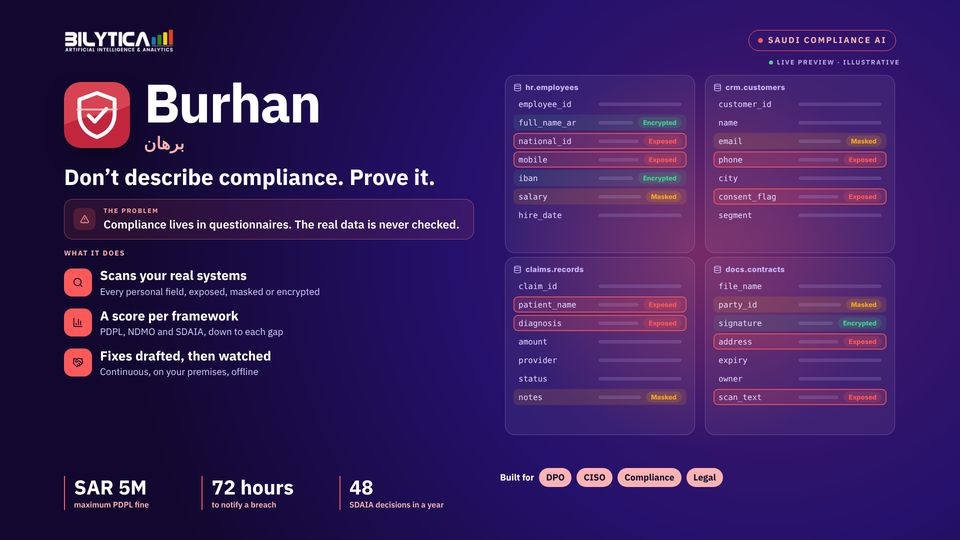
This is Burhan, برهان, which means proof. Burhan scans your real systems, finds every personal field and shows how it is protected: exposed, masked or encrypted. Then it proves where you stand on PDPL, NDMO and SDAIA. Don’t describe compliance; prove it.
A breach is found. The clock starts.
Let me show the problem against the clock. A breach is found and the clock starts: PDPL gives you 72 hours to notify SDAIA. Hour four: which systems hold national IDs? Nobody is sure. Hour eighteen: last year’s questionnaire lists four systems; there are eleven. Hour thirty-six: IT exports table lists by hand. Hour fifty-eight: was it encrypted? It depends who you ask. Hour seventy: an estimate goes to leadership. This is illustrative, but the gap is real.
The policy exists. The evidence does not.
Why does it happen? Because the policy exists, but the evidence does not. The questionnaire says national IDs are encrypted; the data shows them in plain text. It says consent is recorded; the consent field is empty for a third of customers. Questionnaires describe the data. Burhan looks at it.
Continuous, not once a year
Burhan is installed on your premises and works offline. It connects to your databases, warehouses, CRM and documents; discovers every personal field with a confidence score; scores each framework down to the requirement; ranks each gap with its legal reference; drafts the fix; and alerts the moment a score drops. Continuous, not once a year.
One score per framework, and the gaps to close
This is what leadership sees: one score per framework, and the gaps to close, each tied to its framework and ranked by severity, with the fix drafted and the evidence recorded. The figures here are illustrative.
Compliance is now a business risk
Why now? PDPL enforcement has been active since the grace period ended on 14 September 2024. Fines reach SAR 5 million per violation and can be doubled for repeats. You have 72 hours to notify SDAIA of a breach. SDAIA issued 48 enforcement decisions in one year. And the same governance practice that cut supervisory reporting time 85% at a central bank is built into Burhan.
A compliance tool that adds no risk
A compliance tool must not add risk. Burhan is installed on your premises, inside your walls. It works offline, never trains public models, and writes its reports and policies in regulatory Arabic and English. It is built by Bilytica in Riyadh.
Prove your compliance from your own data.
So here is the question to leave you with: could you show a regulator, today, where your customers’ personal data lives and how it is protected? Let’s find out together. Connect one database, warehouse or CRM, scanned on your premises. See your real position: a score per framework, the personal data found and the gaps ranked. Then approve the drafted fixes and monitor continuously. Write to us at sales@bilytica.sa. Thank you.